
Semiconductor Fab Yellow and White LED Tube Retrofit Guide
How to Retrofit Yellow and White Fluorescent Tubes in Semiconductor Fabs with LED Lighting
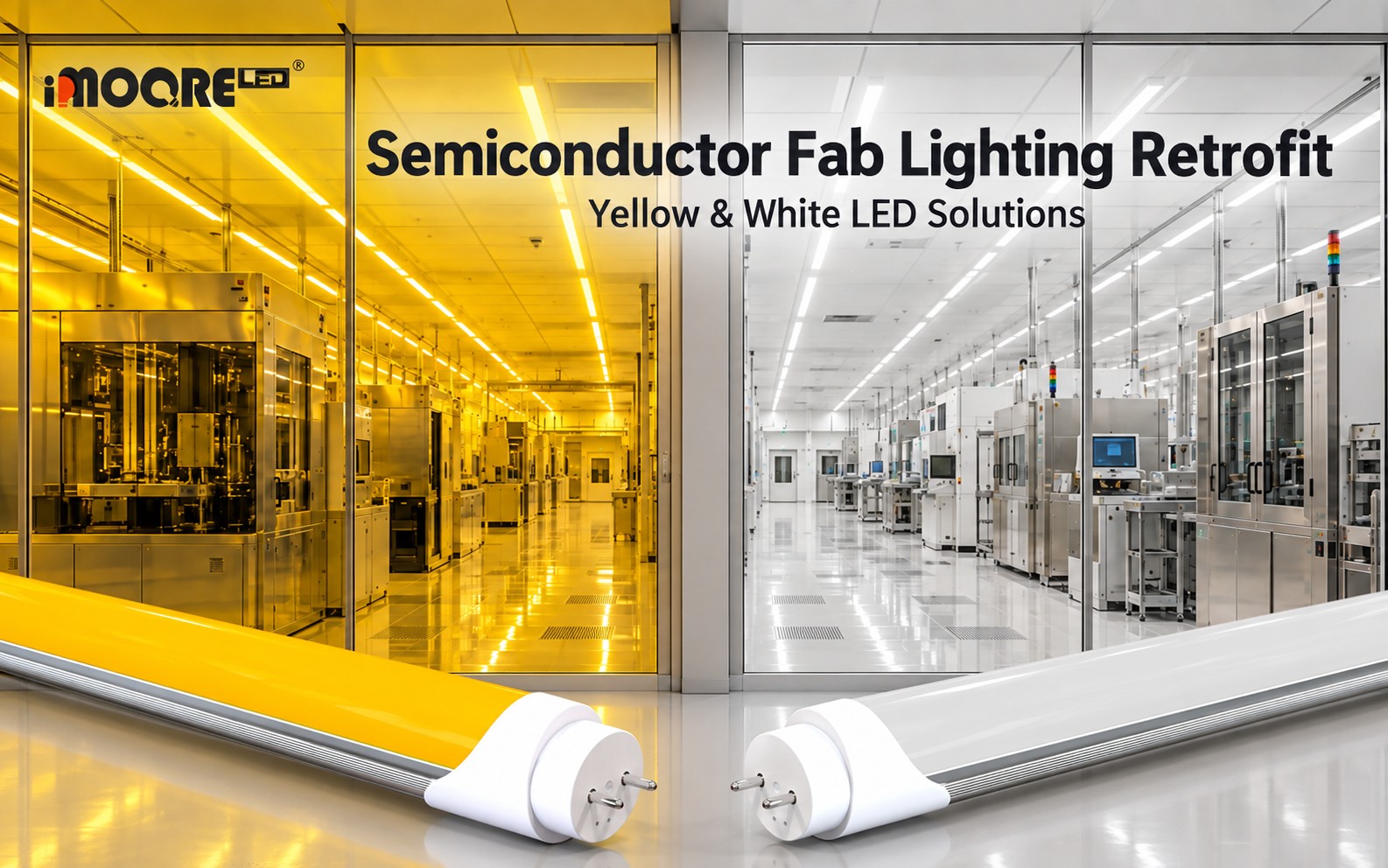
Replacing fluorescent tubes with LED lighting can reduce electricity and maintenance requirements in semiconductor facilities, but yellow-light process areas and general white-light cleanrooms cannot be treated as one standard application. A reliable retrofit must evaluate spectral protection, existing fixtures, electrical configuration, illuminance and
process-specific requirements before full-scale replacement.
Why semiconductor fabs are upgrading to LED lighting
Semiconductor facilities commonly operate for long hours and may use hundreds or thousands of tubes. Aging fluorescent systems can create recurring lamp and ballast maintenance, uneven output and unnecessary energy consumption. A properly engineered LED retrofit can reduce installed wattage, extend service intervals and provide more stable
illumination.However, energy saving is only one part of the decision. In photolithography and other photosensitive areas, the replacement light must also control wavelengths that could affect photoresist or other light-sensitive materials.
Yellow-light and white-light areas require different solutions
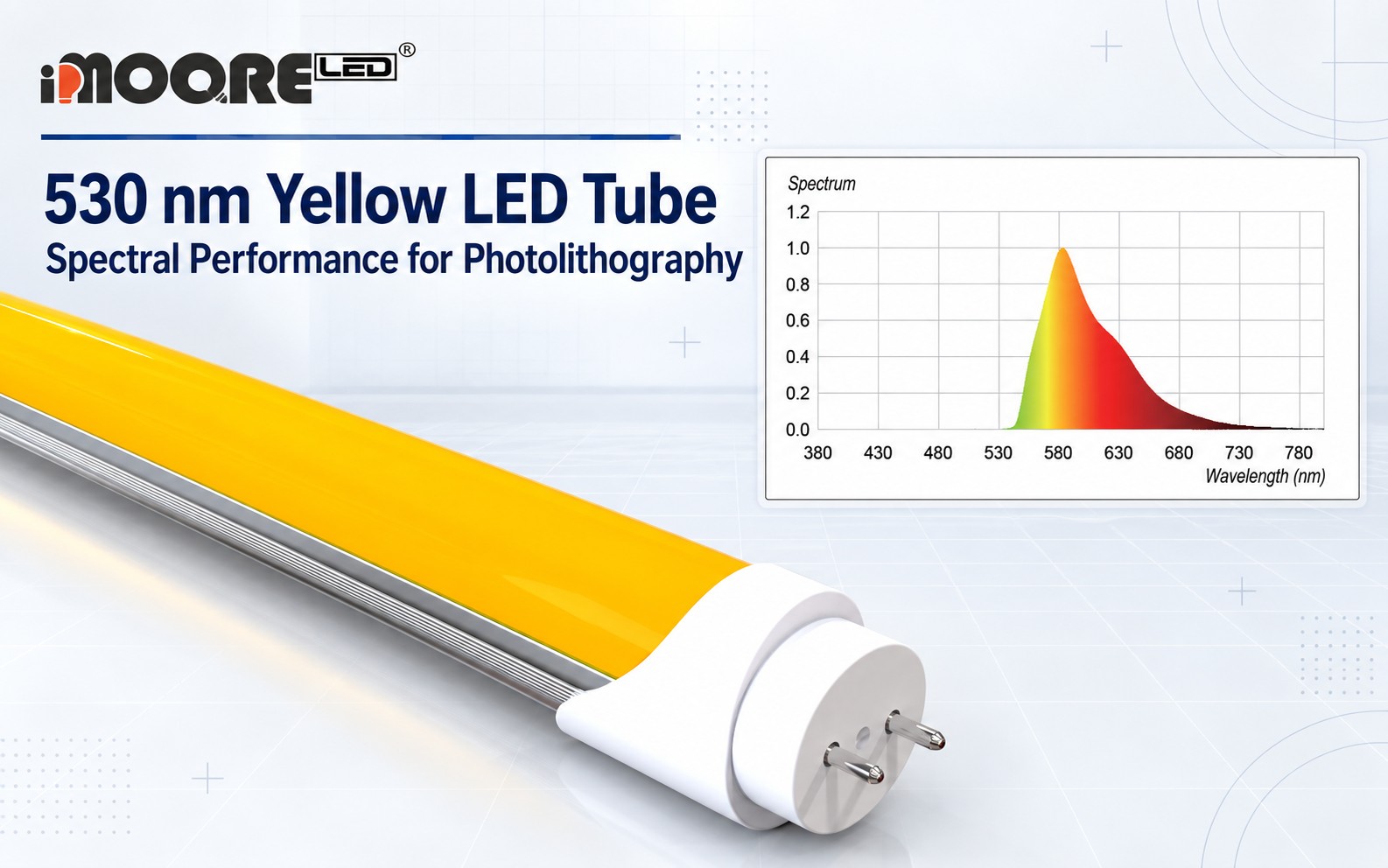
General cleanroom areas usually require white lighting selected according to illuminance, glare, color quality, flicker and cleanroom construction requirements. Yellow rooms require additional spectral control.A yellow lamp should not be approved only because it appears yellow to the human eye. Its measured spectral distribution must be assessed against the sensitivity range of the photoresist and the fab specification. For demanding applications, Moore Technology offers yellow LED tubes engineered to suppress short-wavelength light at and below 530 nm, with maximum single-point transmittance of no more than 0.3% and a blocking rate of at least 99.7%, subject to the applicable test method and report.The final acceptance criterion should always be confirmed by the fab according to its photoresist, process conditions and internal standards.
Information to collect before selecting replacement tubes
| Required information | Why it matters |
|---|---|
| Existing lamp type and diameter | Confirms T5 or T8 compatibility |
| Tube length and lamp base | Confirms mechanical fit and pin configuration |
| Existing wattage and lumen output | Establishes the energy and illumination baseline |
| Yellow and white tube quantities | Separates process lighting from general lighting |
| Input voltage and wiring | Determines driver and installation requirements |
| Ballast type | Determines whether rewiring or ballast bypass is needed |
| Operating hours and electricity rate | Supports annual savings and payback calculations |
| Existing and target illuminance | Helps prevent under-lighting or unnecessary over-lighting |
| Photoresist sensitivity and spectral limit | Defines the required yellow-light protection range |
| Cleanroom and installation requirements | Confirms suitable luminaire construction and access method |
A practical retrofit process
1. Survey the existing installation. Record lamp models, dimensions, wattage, ballast, voltage, quantities, operating hours and lighting layout.
2. Define requirements by area. Separate yellow-light process areas from white-light cleanrooms and supporting spaces.
3. Review spectrum and electrical compatibility. Compare the proposed yellow-light test data with the applicable photoresist requirements and confirm the proposed wiring method.
4. Test samples in a controlled area. Evaluate spectrum, illuminance, uniformity, flicker, visual comfort, temperature and installation compatibility before bulk production.
5. Complete a pilot installation. Install a limited batch in a representative area and collect feedback from process, facility and EHS teams.
6. Approve the rollout plan. Confirm final specifications, labeling,installation procedure, production consistency and acceptance testing.
Estimating energy savings
Annual energy savings can be estimated with the following relationship:
Annual energy savings in kWh = (existing wattage - LED wattage) ×quantity × annual operating hours ÷ 1,000
The calculation should include yellow and white tubes separately because their wattages, quantities and operating schedules may differ. A complete financial assessment should also consider ballast losses,installation cost, maintenance labor, replacement frequency and electricity price.
Moore Technology solutions for semiconductor retrofits
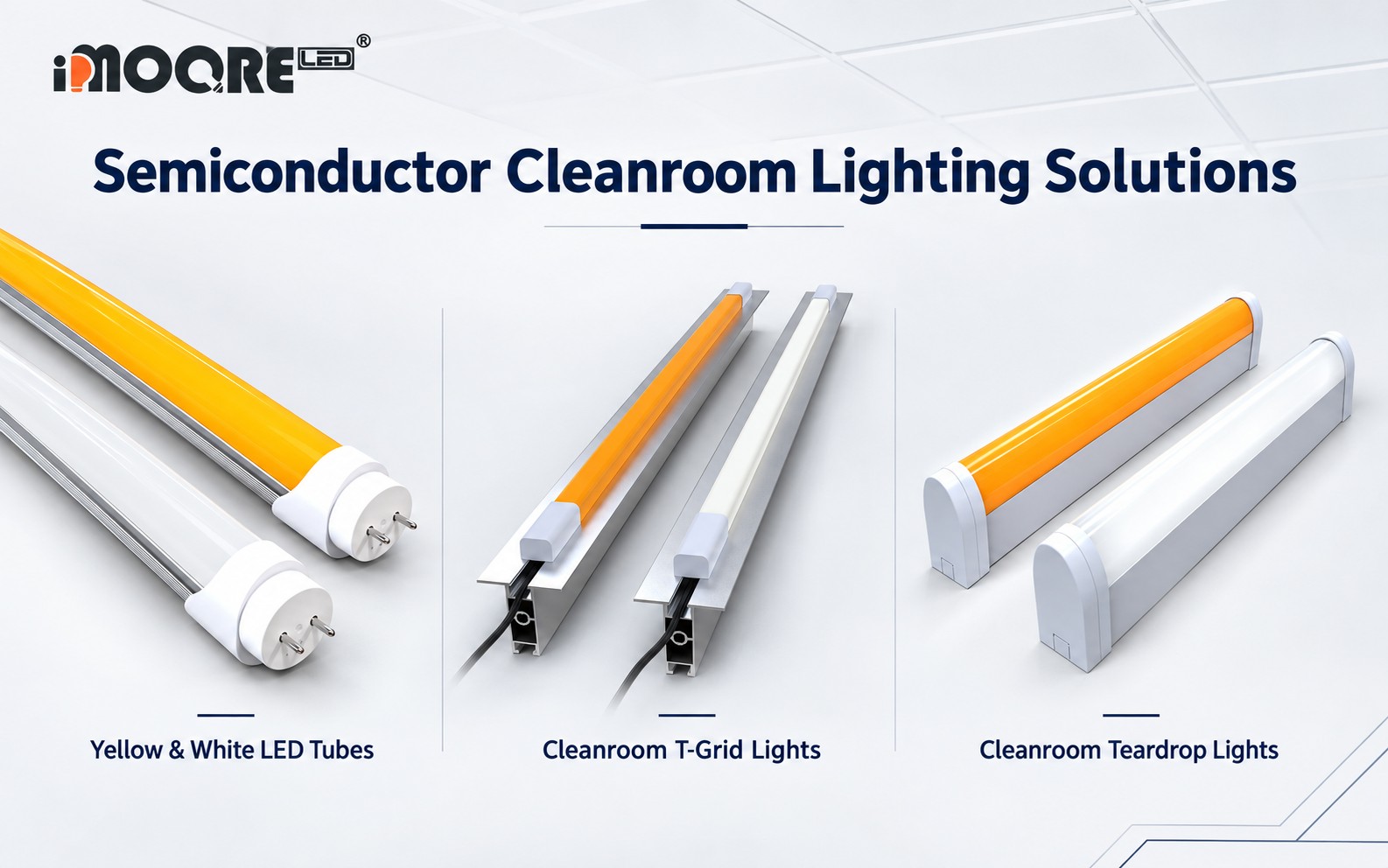
Guangdong Moore Technology Co., Ltd., operating the iMOORELED brand,designs and manufactures LED lighting for semiconductor cleanrooms and photosensitive manufacturing environments. Available solutions include yellow and white LED tubes, cleanroom T-grid lights and teardrop cleanroom lights.
-
Yellow LED tubes engineered for spectral suppression at and below 530nm
-
Maximum single-point transmittance ≤0.3% and blocking rate ≥99.7%,based on the applicable test report
-
Standard efficacy around 100 lm/W and high-efficiency options up to 170 lm/W
-
Wide input voltage range of 100–305 VAC
-
Flicker-free, double-ended power design
-
Nominal lengths of 600, 1047, 1200 and 1500 mm, with customization available
-
Five-year warranty for the applicable product configuration
-
Yellow and white lighting options for coordinated cleanroom retrofit projects
More than one million yellow LED tubes have been supplied for semiconductor and other photosensitive manufacturing applications.
Products supplied to a leading global semiconductor manufacturer have remained in stable operation for more than three years.
Request a semiconductor lighting retrofit assessment
To evaluate a yellow-light and white-light LED retrofit, send us the existing tube model, diameter, length, wattage, quantity, input voltage,ballast type, operating hours, target illuminance and photoresist spectral requirements. Our team can recommend suitable products for sample evaluation and project planning.
Email: wendyluo@mooreled.com; info@mooreled.com | Website: www.mooreled.com | Tel: +86 750 6018123 M:+86 13723445029
Moore Technology | iMOORELED
Moore Light. Pure Precision.
Frequently asked questions
Q: Can an LED tube directly replace an existing fluorescent tube?
A: Not in every installation. The tube diameter, length, base,ballast, wiring and input voltage must be checked. Some projects require ballast bypass or fixture rewiring.
Q: Can one LED tube specification be used in both yellow and white areas?
A: No. White-light areas and photosensitive yellow-light areas have different optical requirements. Yellow areas require verified spectral control.
Q: Is a 530 nm cut-off required for every semiconductor process?
A: Not necessarily. The required limit depends on photoresist sensitivity, process conditions and the fab specification. A 530 nm solution can provide a wider suppression range, but the customer must confirm suitability.
Q: Why is sample testing recommended?
A: Sample testing verifies spectral performance, illuminance, fixture compatibility, wiring, flicker and operator acceptance before a large-scale rollout.
Q: Can yellow and white tubes be supplied as one retrofit package?
A: Yes. Moore Technology can support coordinated yellow and white LED tube selection as well as compatible cleanroom luminaires.
